From Full-Stack Developer to Full-Stack Product Engineer
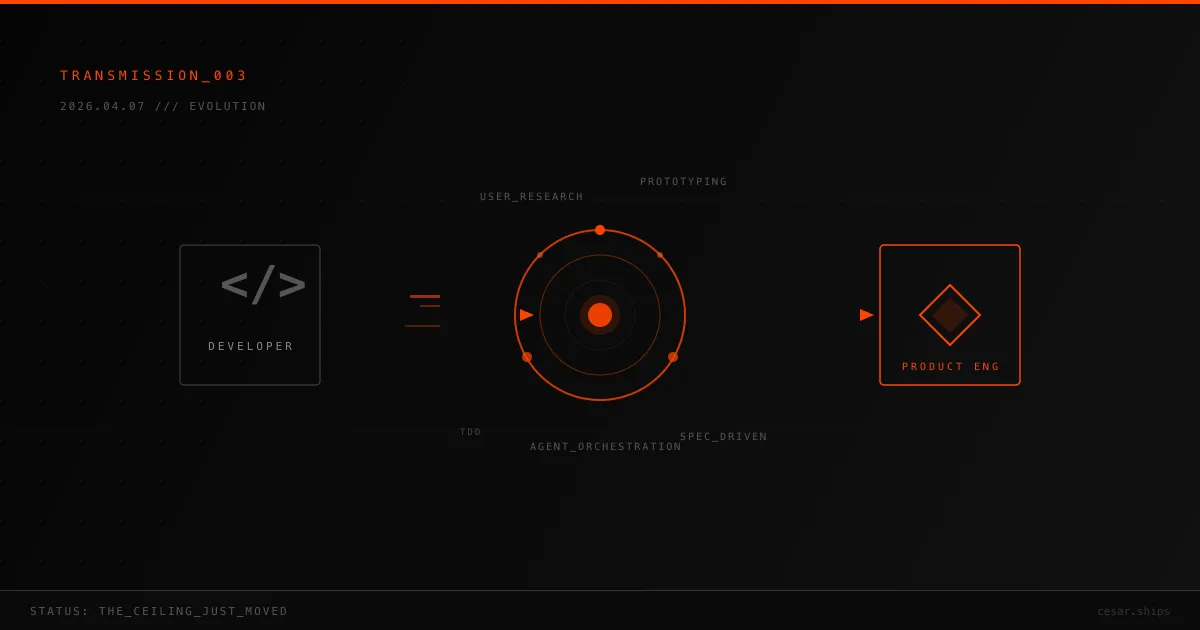
You learned to build entire products end to end. Frontend, backend, database, deployment. For a decade, that was the ceiling.
The ceiling just moved.
The Problem Nobody Is Naming
AI tools are collapsing the skill gap between disciplines. User research, UI prototyping, stakeholder validation: tasks that once required dedicated specialists can now be initiated, iterated on, and validated by a single person with the right mindset and tools.
And yet most developers are still waiting for a brief. Waiting for a designer to hand off screens. Waiting for a product manager to define what to build. Waiting.
Meanwhile, the engineers gaining the most traction aren’t waiting at all. They’re shaping the brief.
Research from elite tech teams confirms what’s already visible on the ground: the developer role is shifting from code author to code reviewer, someone who directs, validates, and orchestrates rather than writing line by line. Senior engineers who embrace this are realizing nearly 5x the productivity gains of those who treat AI as just a faster autocomplete.
This isn’t a prediction. It’s already happening. The question is whether you’ll lead it or react to it.
What Changes When You Stop Being “Just” a Developer
A full-stack product engineer doesn’t just build features. They own a slice of the product experience from end to end:
- Talking to users to identify real pain points, not assumed ones.
- Generating prototypes to test ideas before a single line of production code is written.
- Designing interfaces good enough to be usable without a dedicated designer.
- Validating with stakeholders early, not after weeks of building the wrong thing.
- Shipping informed by all of that, then watching what happens and feeding it back.
The difference is one word: ownership. A full-stack product engineer doesn’t wait for someone else to define the problem. They go find it, shape it, and solve it.
I’m living this shift right now. I’m building a personal project where I handle everything, from user research and prototype validation to product management and development, entirely with AI tools. What used to require a team of specialists is something one person with the right setup can move through end to end.
Five Moves That Make the Transition Real
1. Master the Agent Stack, Not Just the Prompt
Most developers use AI to write faster code. That’s the floor, not the ceiling.
The real leverage comes from learning to orchestrate AI agents as a system: using hooks to trigger automated actions, spinning up subagents for parallel tasks, and composing workflows that execute complex, multi-step work with minimal manual intervention.
But none of that matters without a quality foundation. Test-driven development is the cornerstone of working with AI agents responsibly. Kent Beck, the creator of TDD, calls it a “superpower” in the AI era because your test suite is the feedback loop that keeps agent-generated code honest. Without it, you’re not engineering. You’re gambling.
2. Get Comfortable Talking to Users
This is the biggest mindset shift for most developers. We’re trained to solve problems, not discover them.
Flip that. Start scheduling even informal conversations with users or stakeholders. Use AI to structure the meeting agenda, tools like Granola to record the conversation, and an AI agent with a researcher skill to extract the key insights afterward. The tooling has caught up, and you no longer need a research team to run a proper discovery process. One 20-minute call with a real user will teach you more about what to build than a week of assumptions.
3. Learn to Prototype, Not Just Build
There’s a critical difference between a prototype and a product. A prototype exists to be thrown away. Its only job is to answer a question: Should we build this?
Use AI tools to generate quick UI flows, interactive mockups, and functional demos in a fraction of the time. Validate ideas fast and cheap before committing to full development cycles, and do it yourself, without waiting for a design handoff.
4. Let AI Run Your Project Management
This one is underrated. Setting up an AI agent to create, organize, and prioritize issues in Linear or GitHub is easier than most people think, and it completely changes how you manage complexity.
Instead of context-switching between building and organizing, you stay in flow and let the agent keep your backlog structured, your issues detailed, and your project moving. The compounding effect of this over weeks is enormous.
5. Think in Problems, Not Features
Full-stack developers are trained to think in solutions. “How do I build this?”
Full-stack product engineers think in problems first. “Should we build this, and why?”
This means front-loading effort into detailed specifications before touching any code. Elite teams call this spec-driven development, and it’s one of the most important practices to emerge in the AI era. A good spec doesn’t just clarify requirements, it becomes an executable blueprint for your agents.
The Cycle That Separates Builders from Product Thinkers
Product engineers don’t just ship and move on. They instrument what they build, watch how users actually interact with it, and let the data shape what comes next.
This means owning your product analytics stack. Tools like PostHog, Amplitude, or Mixpanel let you track feature adoption, measure conversion funnels, and run experiments, all things that used to live exclusively in a product manager’s dashboard. Set up event tracking on the features you ship. Define the metrics that matter before you deploy. Monitor retention, activation, and drop-off points after.
The developer who ships a feature and can say “adoption is at 34%, but users drop off at step 3 of the onboarding flow, here’s what I’d change” is infinitely more valuable than the one who says “it’s deployed, what’s next?”
Ship. Observe. Measure. Iterate. Repeat.
This is the loop that turns a developer into someone who shapes products, not just executes on them.
The Opportunity You’re Looking At
This transition isn’t about doing more work. It’s about doing more meaningful work. Developers who evolve into full-stack product engineers will have more autonomy, more impact, and a much clearer seat at the table when product decisions are being made.
The tools are here. The shift is underway. The developers who recognize it early won’t just survive, they’ll define the next era of how products get built.
Your move.
Sources
Google Research. “AI in Software Engineering at Google: Progress and the Path Ahead.” 2025.
Karat. “AI Is Widening the Engineering Skills Gap.” 2025.
Roth, Chris. “Building an Elite AI Engineering Culture in 2026.” February 18, 2026.
With love, Cesar Ardila 🎵